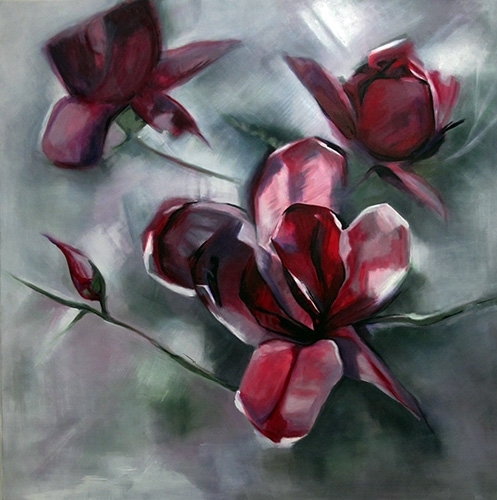
Dhamilo, in Nepali, means matte. Through a restrained and carefully controlled palette, the artist sets a deep, burgundy-tinged red against a range of cool and warm greys, creating a misty, dreamlike atmosphere that draws the flowers out from the ambiguity of the background.
The brushwork throughout the piece is deliberately dual in character: the background is rendered with soft, fluid, semi-blurred strokes — reminiscent of the sfumato technique in classical painting — while the petals in the foreground are executed with sharper lines and a more intense light-shadow contrast. This contrast in execution deepens the spatial depth of the work and guides the viewer's eye toward the central flower, with its half-open petals and theatrical presence.
Thematically, and from a color-psychology standpoint, the dominance of grey tones and dark red lends the piece a contemplative, faintly melancholic atmosphere — far from the conventional vibrancy of floral paintings, and closer to the Dutch tradition of Vanitas, in which the beauty of a flower always serves as a reminder of the passage of time and the fragility of life. The asymmetrical composition and the scattered arrangement of the flowers across the canvas create a non-linear, contemplative rhythm that carries the work beyond the simple genre of floral still life.